Showing posts with label PTC5. Show all posts

Wednesday, 21 June 2017

Positive School Culture

As I reflect on school culture and the impact this has on a school and its community, it is clear to me that school culture whether lead intentionally or not, sets the tone for the school environment. Stoll (1998) explains that culture is a "complex and important concept in education".  Complex, because in my opinion schools bring together a richness of diverse people. Diversity in age, beliefs, experiences, cultures and so much more. William H Trusheim Ed.D (2015) explains this more clearly and says when there is purposeful and intentional leadership of a cultural identity, then there is a greater possibility for successful integration of a positive school culture.

From my own experience, I am privileged to work in a school where this kind of intentional leadership is evident. One of these key aspects of our cultural identity is that we are Positive Behaviour for Learning (PB4L) school. This vision is embedded in all areas of learning and within our staff, students and leadership. We have a passion to see students realise their potential. We celebrate and acknowledge this positive school culture in many ways encouraging students to  
• Strive for excellence 
• Organised for learning 
• Act positively 
• Respect for self, others and the environment

What is the culture that the school is striving for? How is it manifested?
The culture we are striving for is that students will have the skills, knowledge, relationships and experiences to enable them to SOAR into the future with confidence. This is evident in our belief that every child can learn and succeed.  As a staff we spend our weekly staff meetings collaboratively celebrating successes and putting in place strategies to meet any areas of need that are raised by relevant up-to-date data collected. In addition, as classroom teachers, we spend the first 15 -30 minutes of everyday teaching and learning more about our SOAR values and how this looks, feels and sounds in our school. 

Recently I have been part of a new initiative in our school to celebrate students who have been SOARing. Students who have achieved SOAR awards during the week are drawn out of hat every Friday at Assembly, these students get to spend a lunch break in Manu SOAR Zone.  This is a special area in the school where 8 students per week get to play xbox games, shoot basketball hoops, play games, paint, eat popcorn and chill out.


References:
Academy for SELinSchools (2015). What is School Culture and Climate. Retrieved from https://www.youtube.com/watch?v=Z-_NvhlcusQ

Stoll. (1998). School Culture. School Improvement Network’s Bulletin 9. Institute of Education, University of London. Retrieved from http://www.educationalleaders.govt.nz/Culture/Understanding-school-cultures/School-Culture

Wednesday, 17 May 2017

Keep Calm we're a community..

One of the most exciting parts of being a teacher is that you get opportunities to engage with like-minded people, who are working towards being the best teacher they can be for their students. Wenger (2000) maintains that "since the beginning of history people have formed communities that share cultural practises reflecting their collective learning". In this way we develop a community of people with shared goals and interests.

So what is a Community of Practise?

One definition says that "a community of practise is a group of people who share a concern or a passion for something they do, and learn how to do it better as they interact regularly" (Team BE, 2011).

So the key is people united with:
  • Passion 
  • A desire to Learn how to improve 
  • Regular Interaction 
I am privileged to be part of some special communities like this, for example:
School staff
Syndicate team
Church
Women's ministries
Colleagues in local cluster schools focus on digital technologies
Mindlab

For this blog I will focus on our school staff as a community of practise that I will reflect on in more depth.

The three elements of my community :

Domain:

As a range of educators with a variety of teaching experience and special areas of interest. We have a common cause to raise student achievement in our school and improve our teaching pedagogy. We have a passion to see our students achieve their personal best in the short amount of time we have them (Intermediate School). This does not only included core curriculum areas, but general health and wellbeing as well.


Regular Interaction & Activities:

We meet weekly, generally these meetings include some professional development or reflection on our practise. We often have times of professional development by presented by staff in our school or experts in their fields. We are in a constant process of reflection and improvement, committed to be lifelong learners. Presently we are having support from NZCER to assist us with our personal teacher inquiries and how to align this with raising student achievement.

In addition we have been learning how to improve our teaching practise by reading and actively reflectinng on Fullen & Langworthy's (2014) A Rich Seam: New Pedagogies Find Deep Learning. This is then followed by Market Spaces where we can individually or collaboratively present a half an hour workshop to share our learning with our colleagues. We have found this kind of learning very exciting and effective.


What does our community look like:

A vibrant collection of people who are connected to each other in relationship and a deep desire to see progress. My role in this community is much the same for all staff, at times we are leaders, at other times active members.

I look forward to whats ahead for our community of the next few months as we continue to develop our strengths as individuals and as a team.

References:

Fullan, M., & Langworthy, M. (2014) A Rich Seam: New Pedagogies Find Deep Learning. London: Pearson.

Team BE. (2011, December 28). What is community of practice? Retrieved May 15, 2017, from EB Wenger-Trayner: http://wenger-trayner.com/resources/what-is-a-community-of-practice/

Wenger, E.(2000). Communities of practice and social learning systems. Organization,7(2), 225-246.

Friday, 27 January 2017

Deep Learning Tasks

As part of our Teacher Call Back day for 2017 we were required to complete a reading by Fullan & Langworthy (2014) entitled A Rich Seam: Chapter 3: New Pedagogies : Deep Learning Tasks. Further to this we were asked to run a market space during our call back day on an area of the reading that had impacted us personally.

I chose to lead my market space on "Collaboration vs Co-Operation" - This came from some wonderings I had been having about my own understanding of collaboration. We explored this further during our market space.

21st Century Learning Design explains that collaboration is more than one person telling others what to do and they do it ... but true collaboration in when students work together, this requires shared responsibility, making decisions, and their work being interdependent of each others.


My colleagues explaining their new knowledge of collaboration


I created these QR codes to help us understand these terms and how they related to collaboration

Thursday, 24 November 2016

21st Century Learner - Colloboration

Tonight at our MindLab course we explored and discussed Collaboration vs Co-operation. I had never thought about the distinction between the two activities. So I engaged in some reading to support my understanding further.

ITL Research. (2012). 21CLD Learning Activity Rubrics. Retrieved from https://education.microsoft.com/GetTrained/ITL-Research

I have learnt that Collaboration is so much more than just students completing a task together.  Students working collaboratively will be

  • Working together
  • Share Responsibility fairly
  • make substantive decisions together
  • work is interdependent
I look forward to thinking about this more over the next few weeks, about how I can change my pedagogy and classroom teaching activities to be more collaborative.


Thursday, 15 September 2016

Acceleration Market Space Discussions

In our staff meeting we had the opportunity of presenting/ facilitating a table of discussion around acceleration. I choose to participate and show leadership by preparing a discussion around "relevant learning tasks". We had rich discussions in our group about the understandings about the terms "authentic" and "relevant". Here is the google slide with some of our responses. I my opinion this is a discussion that we will continue to have as we work towards acceleration all our students, and enable ākonga to make connections between their prior experiences and learning and their current learning activities

Wednesday, 16 March 2016

Coffee & Blogging

Another great start to the year with our staff coffee & blogging. We meet on Wednesdays at 8 am for a techie time for learning skills to use our blogs more effectively.

Friday, 19 February 2016

iPad set up Part 2

Today I have been working on setting up the 10 new iPads in the school. It is very exciting to be getting new technology into school. I have found the that process has been supported by the installation of Meraki, which allows apps to be installed from a central management system.

Add caption

Thursday, 20 August 2015

PTC sharing and networking

Today we had an opportunity to talk about how we are saving our evidence that we are are meeting the Practicing Teacher Criteria.  Some colleagues are using Evernote, My Portfolio, blogs or paper.


This is an example of sources of evidence that we could use for our PTC criteria.
One goal I would like to set for the coming weeks is to take a video of myself teaching.

Thursday, 16 July 2015

SAMR model


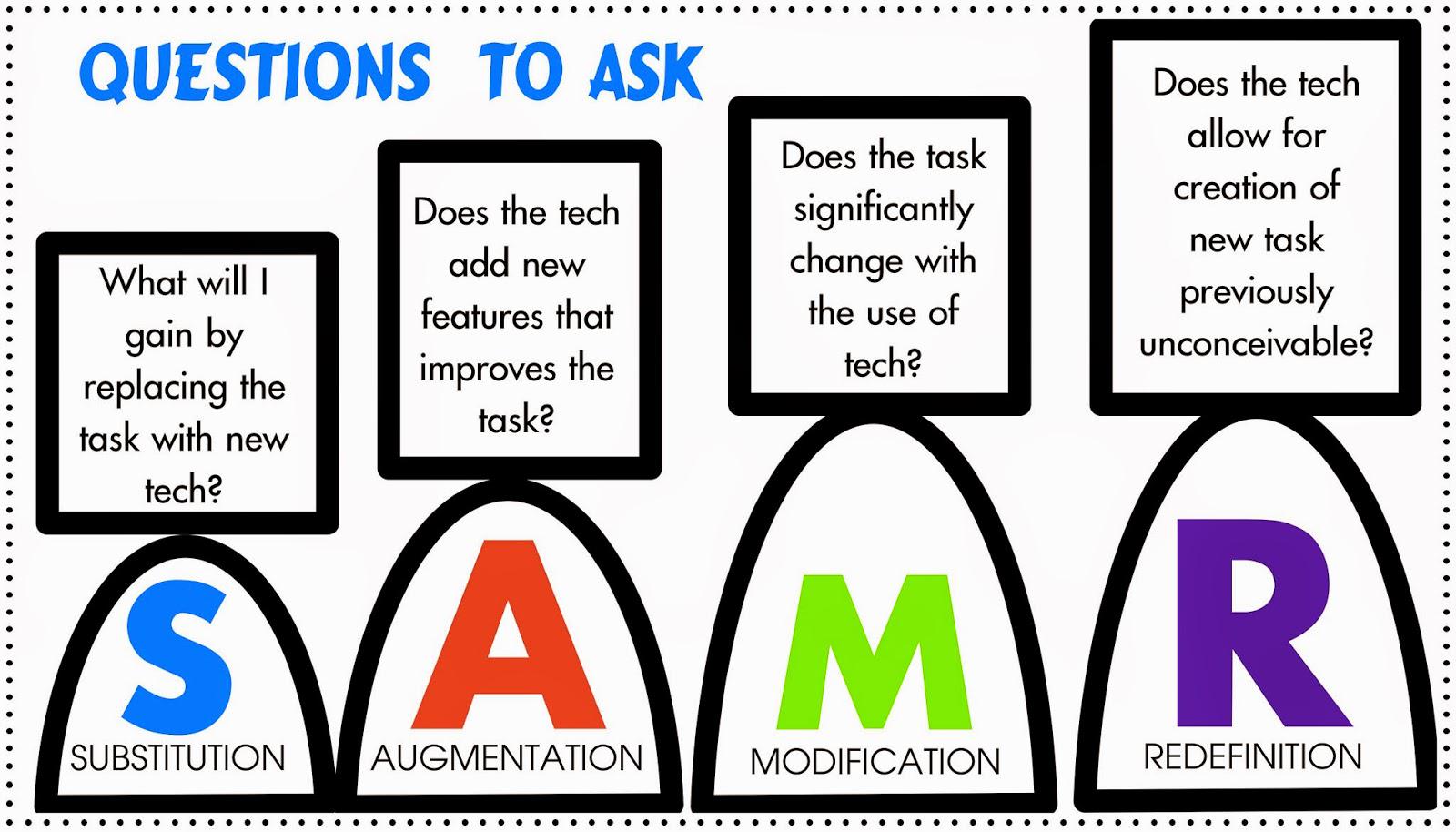
I use Twitter as an online learning environment, where I can keep up to date with new technologies, apps, websites while connecting with other NZ teachers. Today, I came across a post by @makerspaces.com, which has reminded me that the SAMR model is an effective design to refer to when planning to use iPads in the classroom. I am challenged to move from the substitution level to modification and redefinition. I think it is important to ask these questions consistently when planning learning activities.

An example of how I have used this model recently:

Students setting a learning goal.

At  the Substitution level, students could type up their goal and paste this into their books (using an iPad).

However,  at the Modification/Redefinition level, students recorded themselves in a video or Tellegami sharing their learning goal. They posted the video onto their blog, to share with parents, peers, teachers. Students are now able to comment on their own goal as they make progress in achieving it. In this way the technology has allowed for creation of a new task that was previously inconceivable.


Monday, 11 May 2015

Measurement PD


Level
NZC

National Standards
Level 1
Compare Objects Directly
Order & compare objects
·      Length
·      Area
·      Volume + capacity
·      Weight
·      Turn(angle)
·      Temperature
·      Time

By direct comparison and/or counting whole numbers of units

1.

Compare objects directly


2

Compare using self chosen units.
·      Learning in direct comparison
·      Learning A & B is the same as C
Level 2
Create and use appropriate units (standard) to measure.

3

Using standard Units to measure in whole numbers

4

Measure using scales


Level 3
Using linear scales & metric units. Multiplicative thinking
Standard units of measurement

5

Choose & use standard units of measurement.
Time introduces
To the nearest tenth.

6

Use Arrays to find areas & volume ( Whole numbers)


Level 4
Using appropriate devices to measure length, area, weight etc
Decimal numbers
Perimeter and areas of irregular shapes

7

Making conversions.
mm-cm-m-km
Using whole numbes
Regular shares ( squares)

8

Making conversions
Using decimals
Introducing  irregular shapes eg. area & perimeter of triangle


Sunday, 3 May 2015

First 2 weeks using iPads...

It has been an exciting start to Term 2 as the school has embraced the introduction of iPads. Further to my first post on setting up the iPads. We have now installed a few apps, using Meraki, which has been brilliant! It is so easy to assign apps to each device and then install the apps on the iPads.

In addition, we have started a Wednesday morning coffee group before school at 8am for staff to practise using the apps and to share ideas. I am really enjoying sharing what I have learnt about iPads, apps, Google Drive etc and learning from my colleagues. At this stage we are sharing 14 iPads between the classes. The first issue we encountered was how were we going to save students work? The solution at this stage is that students will use the Google Drive app to achieve this.


Students are able to sign into the app and instantly add photos, videos, documents.Once this has been done, students sign out of Google Drive once they are finished with the iPad. Students are then able to view these pictures and videos at home, school, anywhere where they can log into the google account.


To upload photos or videos that are already stored on your device:
  1. Open the Drive app.
  2. In the top right, touch the + button.
  3. Select Upload Photos or Videos.
  4. Touch one or more photos or videos in your camera roll to upload it to Drive.

Issue:
How do we add these videos to blogs?
I have created a short video to explain how I think we can do this...


Friday, 10 April 2015

Setting up iPads

Setting up 14 new iPads in my school has been one of the most exciting and challenging opportunities I have had in my first term of teaching. I can say the excitement has outweighed any learning opportunities along the way :-)

I look forward to how this journey will develop over time. At this stage the 14 new iPads that have been set up and will be managed with Meraki. My next step is to purchase app's which will be pushed out the the iPads.

The Process:

Justine Driver's blog : Setting up iPads & Meraki

I followed Justine's blog instructions, especially the "Next Time" advice. These instructions were crucial in the successful implementation of the VPP account and Meraki. I would have been so lost with out this information. Thank you Justine for recording your experiences for others to use and learn from.

VLN: Volume Purchasing Information

I was reassured to read posts in the Virtual Learning Network from colleagues who have had been through this process in the school and could offer advice and tips. 

Allanah King : Initial iPad Setup 

Allanah's site has tutorials, printable pdf's so show how to use an app and embed it in your blog, app suggestions as so much more.

A special thanks to Scott Walden & Raylene Hunt !!

My learning:

  1. Taking time to read and find information before jumping into any project like this is invaluable and will save time and frustration in the long run.
  2. I found that installing Meraki directly to each iPad using https://m.meraki.com/mdm/ , entering your school's Network Id was the quickest way to invite each iPad onto Meraki.
  3. Factor in time over and above the VPP & Meraki management to set up each iPad from new.
  4. I have actively contributed to my own professional learning, at the same time my enthusiasm in setting up the iPads will hopefully benefit the teachers and students in my school.