Showing posts with label PTC1. Show all posts

Monday, 10 July 2017

Keep Calm and Keep Learning...

Here's what: 
This is my final reflective post of my learning journey through the 32 Postgraduate Certificate in Applied Practice (Digital and Collaborative Learning). During this programme I spend 16 weeks in a face-to-face learning environment and the other 16 weeks online.

So What:
The face-to-face learning component of this paper was a highlight for me. I really enjoyed meeting like-minded colleagues and making new and lasting connections with these amazing people.
  • Criteria 1: Establish and maintain effective professional relationships focused on the learning and well-being of all ākonga.
This course has really helped me to understand and value the importance of these relationships for support, encouragement and mostly to enhance my own practise and my teaching. For me this relates really closely to Criteria 7: Promote a collaborative, inclusive, and supportive learning environment. As I have learnt that I need to understand what collaboration is before I can expect my students to be able to be able to collaborate.  With the help of the course content and further research I have learnt that collaboration is much more than people working together but rather an expression of mutual understanding, shared goals and interdependency. In allowing people to use their strengths in order to achieve a common goal.

image from http://www.spencerauthor.com/wp-content/uploads/2016/06/instagram-cooperation.png


Other highlights include:

  • Challenging my perceptions of my leadership style
  • Learning new teaching approaches
  • Exploring new and exciting digital tools... Who can forget Makey-Makey week!
  • Time management challenges in the busyness of school life.
  • An opportunity to work the Mindlab team to create a Mindlab Promotional video !!!!! 
  • An awesome article about my learning the the Taranaki Daily news!


Now What:

My Dream .... is to continue learning and growing as a teacher. I want to always have a growth mind-set and be open to learning. Hopefully I will be able to go on to do my Masters in Applied Practise in the near future. In the mean time I am planning on going to to do Google Educator Level 1 & 2.

However, most importantly I plan to continue to develop the amazing relationships that I have established through this course. To always "Demonstrate commitment to ongoing professional learning and development of professional personal practice" (Criteria 4).

References:

Ministry of Education (nd). Practising teacher Criteria and e-learning . Retrieved from http://elearning.tki.org.nz/Professional-learning/

Saturday, 1 July 2017

Social Media & Ethics

As I consider some relevant ethical situations linked to digital online media and especially social media, a few dilemma's spring to my mind
  • Do you have a Facebook account for your class? 
  • Do you have to friend the parents/families of your students for them to be in group?
  • Do you accept a student as a member of a classroom Facebook group?
Regardless of the digital media that you do decide to use,  one issue that is often highlighted to me is that of "Netiquette".  Dictionary.com defines 'Netiquette' as the "rules of etiquette that apply when communicating over computer networks, especially the Internet". When we are building relationships with a diverse range of students and families who have their own personal attitudes, values it can be difficult to decide what is good netiquette. Recently Seven Sharp reported in "So what is normal behaviour online?" a range of responses to what is acceptable behaviour online. 


What do you think of the range of responses? Can you see a pattern?

To me there definitely seems to be some blurred lines about what to post online. So in my opinion we need to be aware of this dilemma, and work towards some common goals for online posts.

The Code of ethics states for teachers & learner to :

Carefully consider the tone and content of your posts or messages when using social media as a teaching tool – think about how it compares to how you present yourself in the physical learning environment

With this is mind I have started to work with students in my class to help them to pratise writing posts using Todays.meet. I will prompt a question and allow the student to reply in a respectful manner. In addition I have created a simple tool to assist students to write blog comments. At the same time, modelling correct online behaviour is one of the most powerful tools we have as teachers (Connecticut’s Teacher Education and Mentoring Program, 2012).

I look forward to hearing from you about ways your school is preparing students to be respectful and show etiquette online?


References

Education Council of Aoteroa New Zealand 2017. (2017) Commitment to Society. Retrieved from http://teachersandsocialmedia.co.nz/guidelines/commitment-society

Connecticut’s Teacher Education and Mentoring Program. (2012). Ethical and Professional Dilemmas for Educators: Facilitator’s Guide. Retrieved fromhttp://www.ctteam.org/df/resources/Module5_Manual....


Tuesday, 16 May 2017

Digital Technologies and Writing

During my recent appraisal discussion with my team leader, we spoke about how I would like to focus more specifically on our school wide focus of raising achievement in writing for Māori students (especially boys)

Focus Question: 
How can I use digital technologies to increase engagement and acceleration with writing?


My thinking at this stage is that students are more engaged, accountable and have increased confidence when writing using digital technologies. Together with the collaboration, modelling and effective feedback can lead to improvement in students writing achievement.


Tuesday, 25 April 2017

Best 12 Hours of PLD.... #edtechteam Google Summit 20/21 April 2017

Last week I had the privileged of attending the Google Summit hosted by Edtech in Auckland (Aorere College). 

My highlights from the conference

  • establishing and maintaining professional relationships by connecting with educators from all over New Zealand. I was excited to meet Richard Wells, author of "A learner's paradise, How New Zealand is reimagining education". His key note message motivated me to think about how I am giving agency to my students. 
  • So many practical tools to use in the classroom, A-Z of Googley Goodness from Kim Sutton's was amazing. 
  • On going professional learning, especially around Computer Science. I am looking forward to showing leadership by sharing this new learning.
  • Digit-Tastic Modelling books - WOW
  • Learning more about the Admin console for GSuite
  • Talking to other educators regarding becoming a Google Educator and gaining Level 1 and 2. 
  • Discussing future focused plans with colleagues at local primary school. Finding ways to bridge the gap and develop collaboration between the local cluster of schools.
  • Adding to Twitter


Friday, 3 March 2017

Digital Technologies and the NZC - whats it all about

Today I joined my colleagues at Puketapu School for a CORE breakfast. Tim Bell led us through a presentation of how students can engage in activities around digits (Digital Technology). We all use digital technology everyday, programmes are written for people.
Some key points from further reflection...


--------------------- 


Tim Bell - http://csunplugged.org/

Hashing numbers (Barcode)
9 1 9 2 2 2   ----   5
4 4 5 2 0 7  ------ 2 always x 3  = 1 what bring it up to 0 (10)  = 9 last letter of barcode

Digital Technology: digits 

Students - Can add barcode's 

You can use Scratch to create a programme, to calculate your formula/barcode. 

What is special about digital technology? Digits 

Pixels - picture element (RGB numbers for each pixel) human eye can see red, blue, green. 


----------

Digital technologies to become part of the national curriculum

http://www.edgazette.govt.nz/Articles/Article.aspx?ArticleId=9323
-----------


Computational Thinking :

http://barefootcas.org.uk/barefoot-primary-computing-resources/concepts/computational-thinking/


--------

Diversity is celebrated in the technology field. Students should have opportunities to learn more to be able to work in this field. How am I doing this in my teaching?

Monday, 27 February 2017

Looking closer at assessment data

Today our professional development focused on using data from assessment and what we know about what makes students learn to think about how we can raise achievement. We learnt how to use the student over time report to compare scale scores to reflect on a students learning over a year. 

My key learning today has been about selecting the appropriate test for the student. This will help me receive more accurate information to make the decisions of 'where to next' for a student.


Friday, 27 January 2017

Deep Learning Tasks

As part of our Teacher Call Back day for 2017 we were required to complete a reading by Fullan & Langworthy (2014) entitled A Rich Seam: Chapter 3: New Pedagogies : Deep Learning Tasks. Further to this we were asked to run a market space during our call back day on an area of the reading that had impacted us personally.

I chose to lead my market space on "Collaboration vs Co-Operation" - This came from some wonderings I had been having about my own understanding of collaboration. We explored this further during our market space.

21st Century Learning Design explains that collaboration is more than one person telling others what to do and they do it ... but true collaboration in when students work together, this requires shared responsibility, making decisions, and their work being interdependent of each others.


My colleagues explaining their new knowledge of collaboration


I created these QR codes to help us understand these terms and how they related to collaboration

Thursday, 24 November 2016

21st Century Learner - Colloboration

Tonight at our MindLab course we explored and discussed Collaboration vs Co-operation. I had never thought about the distinction between the two activities. So I engaged in some reading to support my understanding further.

ITL Research. (2012). 21CLD Learning Activity Rubrics. Retrieved from https://education.microsoft.com/GetTrained/ITL-Research

I have learnt that Collaboration is so much more than just students completing a task together.  Students working collaboratively will be

  • Working together
  • Share Responsibility fairly
  • make substantive decisions together
  • work is interdependent
I look forward to thinking about this more over the next few weeks, about how I can change my pedagogy and classroom teaching activities to be more collaborative.


Saturday, 15 October 2016

Algebra .....

After analysing assessment information from Term 3 I have identified some ongoing needs for the students in my class. One area of need for mathematics has been identified as spatial patterns, equals sign (algebra).

This has lead me to critically examine my own pedagogy and I realise this is an area in my teaching that needs improvement. Therefore to "fill the gap" in my students learning and accelerate I have made it a priority to engage in conversations with expert teachers in my school, NZ Maths and professional readings to support my teaching.

Here's what I have learnt :
  • Start with small steps - students look at patterns, decide what is happening in the patterns lead students to find a way to records their thinking (tables) before trying to decide on a rule for the pattern. 
  • "When students problem solve and use a table with geometric pattern tasks, they are taking the first step into the world of functional thinking"  (Friel S.N., Markworth K.A., 2009)
  • Friel & Markworth describe the phases of problem-solving of geometric patterns


  • Thinking the row number, sequence number as the stage number (n) and the total number of blocks as (t)

Thursday, 15 September 2016

Acceleration Market Space Discussions

In our staff meeting we had the opportunity of presenting/ facilitating a table of discussion around acceleration. I choose to participate and show leadership by preparing a discussion around "relevant learning tasks". We had rich discussions in our group about the understandings about the terms "authentic" and "relevant". Here is the google slide with some of our responses. I my opinion this is a discussion that we will continue to have as we work towards acceleration all our students, and enable ākonga to make connections between their prior experiences and learning and their current learning activities

Monday, 15 August 2016

Orchestrating Mathematical Discussion

Anticipation:
Before giving an activity, to antiquate all the answers the students may give.
Really good to do this collaborative planning.
Clear learning intention. To know what you are looking for. 

Monitoring: 
Monitoring sheet of differently levels students could achieve.
What you anticipate can become your monitoring
Questions are key. If you see level 2 working out, you could ask some questions that could allow student to try a higher up strategy.

Selecting:
Select students to share their work, choose students who have achieved the goals you aimed to achieve. Teacher can choose which answers/strategies to share with class.

Sequencing:
Going over a various responses.

"By making purpose-ful choices about the order in which students’ work is shared, teachers can maximize the chances that their mathematical goals for the discussion will be achieved. For example, the teacher might want to have a student present the strategy used by the majority before one that only a few students used" (Mathematical Teaching in the Middle School)

Connecting:
Connecting the Key ideas. 


Friday, 22 July 2016

First Aid course

Today we participated in a First Aid Course. Our focus was on CPR and using the AED (external defibrillator)
Check for breathing (10seconds)
Open airways
Start CPR - 30/2 ... Children one hand, infants 2 fingers
Press 1/3 distance of chest.
If the patient vomits , turn to side (recovery position) 

If using AED... Remember to keep everyone clear when shocking. 


Tuesday, 31 May 2016

Literacy : comparing level 3 and 4 of NZC (Listening Reading Viewing)

Today in our team meetings we had a discussion about the differences between Level 3 and Level 4 of the NZC (Listening Reading Viewing strand)

Our thoughts ..

Level 3 - From purposes/audiences to Structure: show developing….developing understanding...Level 4 shows an increasing. Understanding…

  • Importance of being able to see the difference of developing and increasing.
  • Examples:  When reading a student at level 3 may refer to images/diagrams to support their reading. Whereas a student level 4  would be referring back to these images/diagrams to increase their understanding of the text eg. Water Bottle Rockets, students would be looking at diagrams or videos together with text to help them understand what they are reading.
  • When reading a text/viewing images at level 3 uses their prior knowledge (text to text, text to self, text to world to help make meaning.  Whereas Level 4 students are using their knowledge to help understand more complex ideas.


Thursday, 26 May 2016

Visit to Room 7... exploring geometry...

This week I visited Room 7 with observe Sally teaching Geometry.  I thought that the idea of using Kadinsky Art as an exciting context for geometry would be a great for my class.  Using the image below the lesson was to :


Encourage students to examine the picture and discuss with their group and record what maths they can see ( ie …circles, angles, perpendicular lines etc)
-        Students can also complete a personal response to the painting too
-        Explore the maths language that can be used to describe 2D shapes, lines and angles. Teach the students about the different names that can be used to describe a square ( polygon, cuboid, square, parallelogram , quadrilateral, etc), circle etc.
-        Teach the different angles / combinations of lines  and then repeat the art response with a different picture

-        Using plastic cut out shapes have the students design their own Kandinsky inspired art work, with an explanation of the  maths used to create it. 


Now What:


I am looking forward to teaching geometry next week, and I will be using this lesson and adapting it to the learning needs of the students in my classroom.
Some key learning that has happened for me and that will benefit my students is that:

This lesson will activate students prior knowledge, and an opportunity to re-visit previous learning

I have a better understanding of the vocabulary needed to teach geometry. I am planning of giving students TIP sheets with the basic geometric shapes.

*** An idea - students could sort angles according to similarities and differences (Suzy Pepper Collins)


Tuesday, 10 May 2016

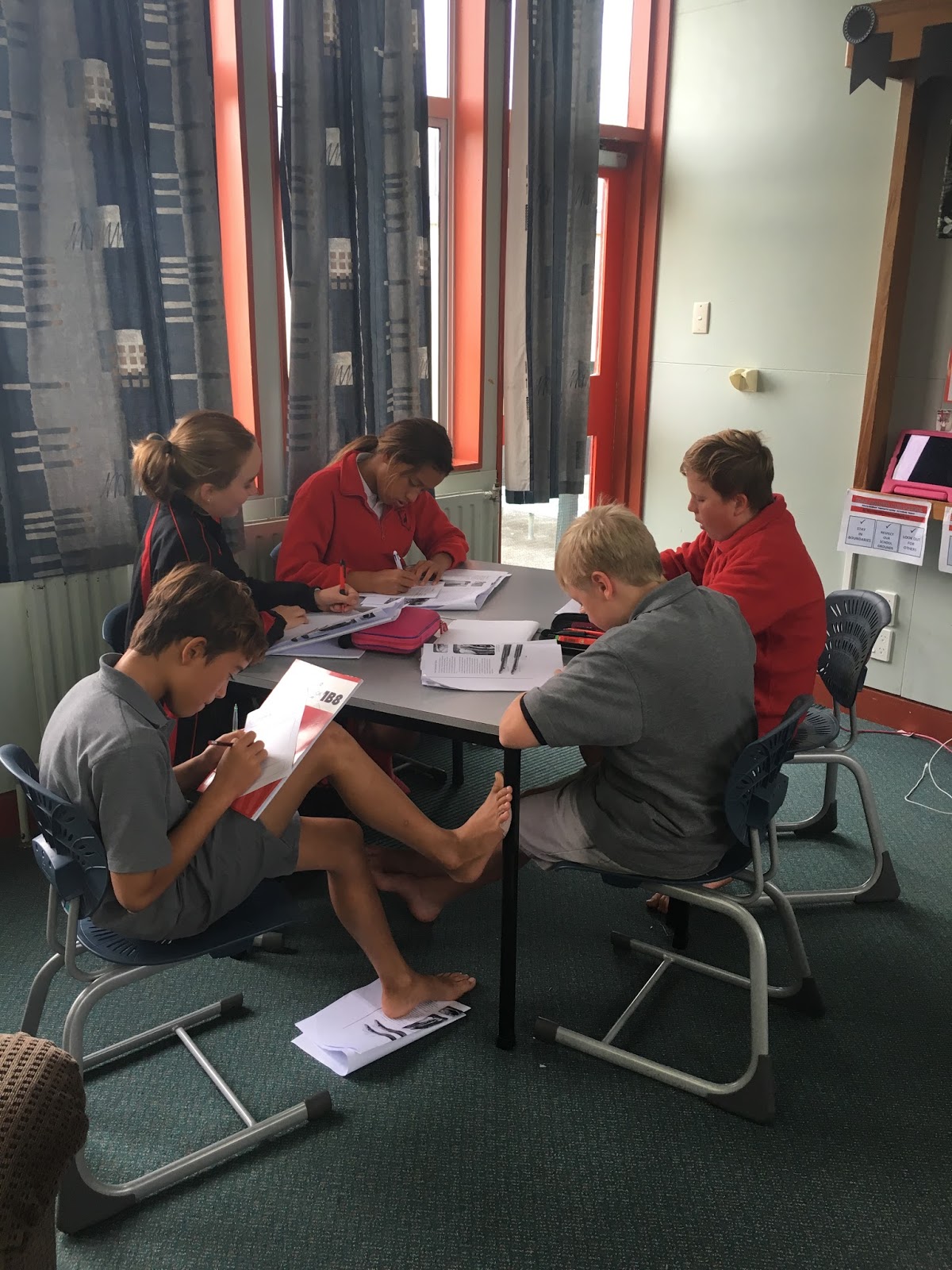
Literacy Circles

Today we had the pleasure of a visit from some amazing students in Room 8. They came to show us the different roles of Literacy Circles. We look forward to putting these new skills into practise tomorrow.

I was able to observe students and a colleague teaching/modelling the Literacy Circles. Thereby actively engaging in respectful relationships with students, peers and colleagues.  At the same time initiating learning opportunities to advance my professional knowledge and skills. 
The Illustrator draws their own interpretation of a section of the text.
Students commented that the enjoyed working with their peers and learning from each other.

The Word Master selects key vocabulary from the text.

Wednesday, 13 April 2016

Ideas to support acceleration


This week I have gathered a range of maths activities, games with resources for an identified target group on my class.  I am hoping that these students will be able to enjoy these activities in the holidays. Next term I will be running an after school maths club with a focused time of 45mins. This initiative has come from the key ideas from "Jump-starting students who are behind" by Suzy Pepper Collins.