Showing posts with label PTC2. Show all posts

Tuesday, 16 May 2017

Digital Technologies and Writing

During my recent appraisal discussion with my team leader, we spoke about how I would like to focus more specifically on our school wide focus of raising achievement in writing for Māori students (especially boys)

Focus Question: 
How can I use digital technologies to increase engagement and acceleration with writing?


My thinking at this stage is that students are more engaged, accountable and have increased confidence when writing using digital technologies. Together with the collaboration, modelling and effective feedback can lead to improvement in students writing achievement.


Friday, 17 March 2017

SUCCESSES, CHALLENGES, SURPRISES

Google Classroom 2 months on and I am already seeing the benefits. I am including this extract from our Digital 2 Assignment, which really explains our experiences up to this point.


“One great use of Google Classroom is the ability to ‘flip’ your classroom.” (Mercier, (Ministry of Education, 2007)2016, p. 7). To ‘flip’ a classroom is to allow students the ability to view content before a lesson, in order for them to be front loaded and ready to engage in the learning for the lesson. We feel that Google Classroom is a suitable tool to do this. By simply adding a ‘Comment” or ‘Question’ in the stream page we could send out a video, comments, google slides, web link. Students were then able to work at their own pace, therefore self-regulating their learning. Not only do students have the ability through Google Classroom to self-regulate their learning, from our experience there is a huge advantage for teachers. That being, time saved from printing off paper assignments, students cutting and glueing into books (inevitably losing them).  Earl & Forbes (2012) list one of the key advantages of using digital technologies “can help teachers and students work smarter not harder” (p. 227).  This has been our experience thus far, with an exciting promise of more to come.

Pauline Henderson (2016) explains that with the innovation of online environments such as Moodle and Google Classroom, teachers are finding that even though they may only have students for a short time in the day, that with these digital technologies “the learning doesn’t stop after they leave your classroom”. This has been evident in the use of Google Classroom as our innovation, in particular one student (Susan) has regularly completed her work at home to a much higher standard than when she works in the classroom.  Susan has shown that using Google Classroom in this way can give students ownership of their learning,  and that the learning can happen at any time in an ubiquitous environment. “Increasingly, mobile devices equip students to take charge of their own learning in a context where learning occurs anywhere, anytime, and with access to a wealth of content and interactive tools” (21st Century Learning Reference Group, 2014).  

In the same way we have found that Google Classroom allows for rich discussions through the commenting option. “You could provide individual students feedback on how they did that day or let them reflect on their own performance and then give comments. It is a very powerful too” (Mercier, 2016, p. 8). We absolutely agree with this statement. Google Classroom not only allows teachers to communicate effectively and personally with a student but in addition Google Classroom encourages “more specific and descriptive feedback to assessments which lead to greater motivation and achievement. Hill (2012)  reiterates this by adding that “this involvement and understanding about why they are learning gives students more control over the learning” (p. 168) which results in a more positive result.

Learning Goals and success criteria are an integral process when working towards students having self-management. “When students are aware of these important learning parameters before they complete the work, they can begin to consider how to manage and monitor their own learning” (ITL Research, 2012). We used Google Classroom to share this information to each student as part of the learning.  Students had the opportunity to use our pre-made slide with an example of the expectation of the assignment, along with the learning goals and success criteria. Students could then use our slide for their assignment or create their own. In the three assignments given to students during this innovation time, only one student chose to use our slide. The other students chose to create their own presentation. As students were clear on the learning parameters this could have given them the confidence to work knowing how to be successful with the task.
As we seek to motivate students to develop self-regulating skills we know that will be “when learners can make decisions on how to organise and reflect on their learning, they develop the ability to self-monitor. These self-management skills create lifelong learners” (Ministry of Education, n.d.). During these initial stages we have felt that Google Classroom has been a support to enable students to successfully make decisions about their learning. However, Google Classroom alone will not encourage these skills. As a teacher many of these skills are taught and developed in the classroom through all areas of learning. Our pedagogy has had the biggest shift in the past year.  So while digital technologies like Google Classroom can be a tool for teachers to enable students to be able to learn in an ubiquitous environment this is not the recipe to achieving learner agency.

One difficulty when using Google Classroom has been teaching students how to use this digital technology. Although students were familiar with Google Slides, Google Docs, this was a new step in their digital learning experiences. At the same time this was an opportunity for knowledge construction.  Students could use their previous knowledge of Google Apps for education to “develop new knowledge, through integration of prior knowledge with ideas, information and concepts, into a wholly new product, concept, solution or content” (Fullan & Langworthy, 2014, p. 23).  From our observations and discussions students would ask lots of questions about how to get into Google Classroom and how to find what they needed for the task. New learning takes time, therefore much time and effort was taken to support students to develop their confidence with using this tool.


One surprise success for us as the teacher was the ability to view each individual student's progress with an assignment/task in one page under the ‘Work’ tab, in Google Classroom. What a time saver ! Previously using Google slides each student would have shared their slide show with the teacher to view, which meant going to emails for google drive to search for each presentation. Google Classroom has revolutionised this and now with the convenience of one page you are able to view each student's presentation and make personal comments on each one. This is exciting and provides motivation for us to continue to use this digital technology in our practice.

References:
21st Century Learning Reference Group. (2014, May 30). FutureFocusedLearning30May2014.pdf. Retrieved February 29, 2017, from Education.govt.nz: http://www.education.govt.nz/assets/Documents/Ministry/Initiatives/FutureFocusedLearning30May2014.pdf
Earl, K., & Forbes, D. (2012). Transforming Learning Through ICT: Swimming with Dolphins. In C. McGee, & D. Fraser, The Professional Practise of Teaching (pp. 224-244). Melbourne, Australia: Cengage Learning Australia.
Educational Media. (2014, June). COLLABORATION = INNOVATION: DELIVERING EDUCATION WITHOUT BORDERS. Retrieved from Edducation Review: http://www.educationreview.co.nz/magazine/june-2014/collaboration-innovation-delivering-education-without-borders/#.WLszi9KGODI
Fullan, M., & Langworthy, M. (2014). A Rich Seam: How New Pedagogies Find Deep Learning. London: Pearson.
Henderson, P. (2016, February 17). Modern Learning Practice in the Secondary School. Retrieved March 1, 2017, from Core Edtalks: http://edtalks.org/#/video/modern-learning-practice-secondary-school
Hill, M. (2012). Using Classroom assessment for effective learning and teaching. In C. McGee, & D. Fraser, The Professional Practice of Teaching. Melbourne: Cengage Learning Australia Pty Limited.
ITL Research. (2012). ITL Research. Retrieved March 1, 2017, from Education Microsoft.com: https://education.microsoft.com/GetTrained/ITL-Research
Mercier, N. (2016). Using Google Classroom to Teach Music. Kodaly Envoy , 42 (4), 7-8.
Ministry of Education. (n.d.). The Learning to Learn Principle. Retrieved March 3, 2017, from TKI: http://nzcurriculum.tki.org.nz/Curriculum-resources/NZC-Updates/Issue-21-May-2012
Ministry of Education. (n.d.). Using digital technologies to support learner agency. Retrieved February 25, 2017, from enableing e-Learning: http://elearning.tki.org.nz/Teaching/Learner-agency

Friday, 10 March 2017

The Story of Whaitara ~ Digital Storytelling

During our recent stay at Owae Marae, myself and a colleague had a privileged of running a workshop on creating digital recordings of the story of Whaitara. Here are two examples, one is a stop motion video and another a oral recount by a 11 year old student. 


Whaitara - Audio (Retold by Sam)


Wednesday, 14 December 2016

Using EDPuzzle to create a flipped learning lessons

This week we learnt more about flipped learning. I was really excited to experiment with Edpuzzle. Edpuzzle enables you to edit YouTube videos by cutting them, adding questions or comments. This would be such a great tool to use and I am definitely planning on using it next year.

What Stuck with me: tonight we discussed how a video like the one we created could be used as homework. Instead of giving students homework following on from what they have already learnt, you could give them a video to watch and front load them with the information needed for a class discussion later in the week.


Thursday, 15 September 2016

Acceleration Market Space Discussions

In our staff meeting we had the opportunity of presenting/ facilitating a table of discussion around acceleration. I choose to participate and show leadership by preparing a discussion around "relevant learning tasks". We had rich discussions in our group about the understandings about the terms "authentic" and "relevant". Here is the google slide with some of our responses. I my opinion this is a discussion that we will continue to have as we work towards acceleration all our students, and enable ākonga to make connections between their prior experiences and learning and their current learning activities

Friday, 29 July 2016

Accelerated learning in mathematics

Here's What:
On my journey for inquiring into accelerated learning to support achievement in mathematics . I have found that I am constantly reflecting on my teaching practise and looking for ways to effectively teach my students.   From my recent observations in class some students have not moved beyond using repeated addition for solving multiplication and division problems.

So What:
To help me understand how I can better support these students,  I read an article from the NZ Maths website.


Some highlights for me was a reminder of the key principles for effective teaching in mathematics. 

1. An ethic of care 
2. Arranging for learning 
3. Building on students’ thinking 
4. Worthwhile mathematical tasks 
5. Making connections 
6. Assessment for learning 
7. Mathematical communication 
8. Mathematical language 
9. Tools and representations 
10. Teacher knowledge

  • Practical examples for teaching arrays to solve multiplication and division problems
  • Addressing barriers such as lack of confidence which could lead to creating visual flow charts with new facts to be learned
  • Revisit inverse nature of mult/div and to reinforce that division equations can be found using known multuplication equations.


Now What:

I found that the deliberate acts of teaching suggested in this reading would be beneficial for the students in my maths club group. So I plan to go through the steps suggested next week. 


Thursday, 2 June 2016

Maths Club .... activating prior knowledge

Working with target students at maths club today, we had a brainstorm about all that we knew about geometry, shapes, angles.  The goal of the lesson was to introduce vocabulary will activating prior knowledge,  to stimulate thinking and scaffold critical missing missing pieces of knowledge.


Wednesday, 13 April 2016

Ideas to support acceleration


This week I have gathered a range of maths activities, games with resources for an identified target group on my class.  I am hoping that these students will be able to enjoy these activities in the holidays. Next term I will be running an after school maths club with a focused time of 45mins. This initiative has come from the key ideas from "Jump-starting students who are behind" by Suzy Pepper Collins. 


Friday, 25 March 2016

Acceleration....

Here's What:
Last week I decided to base my mathematics teaching around the acceleration strategy that we had learnt about in our recent professional development.

The keys from our reading "Jump-starting students who are behind" by Suzy Pepper Collins was to 
  • make learning experiences relevant (real-world relevance)
  • rich vocabulary experiences
  • hands on experiences

The learning in the classroom is fractions, decimals and percentages in every day life focusing on students being able to use a range of additive and multiplicative strategies with whole numbers, fractions, decimals and percentages.

I attempted to achieve this by creating a learning experience where students could use the current Warehouse mailer to go shopping for easter eggs for their family, and buy something for themselves with a budget of $120. What fraction of the money would they spend on themselves? What fraction of the money would they spend on easter eggs?

So What?

As a teacher I enjoyed teaching/guiding students in this lesson. I was thrilled to hear rich mathematical conversations among students. The barriers of grouping and ability was removed and all students engaged in the learning.

Have a look at our blog, to see first hand students enjoying the relevant, hands-on learning experiences ...      Room 13 - Easter Challenge

Now What?
I would like to implement more learning this way. As identified in assessment data, the students in my class need the most support in learning Addition/Subtraction.
I wonder how I can incorporate this learning in a relevant context for my students??


Wednesday, 9 March 2016

Sam's journey ...

A week later and Sam is already making significant progress with his iPad. One of the most exciting changes is that the iPad is enabling Sam to become part of the class learning. 

This week he has accomplished the following:-

Creating images using PicCollage to record the day of the week, and the weather for the day.  In the future we are hoping to collate these images into an iBook (with support of his teacher aide).


Using Write About App, Sam has produced some independent writing. In addition he completed a short piece of writing about a summer barbeque experience. This is the first time that Sam has joined in a class writing task! 


Sam used emoticons to add to his writing.


Using the Matific App, Sam worked with the support of his teacher aide to complete fraction maths activities.


My HIGHLIGHT...


Sam has started working with other students in the class.


Sunday, 20 September 2015

One day Wananga

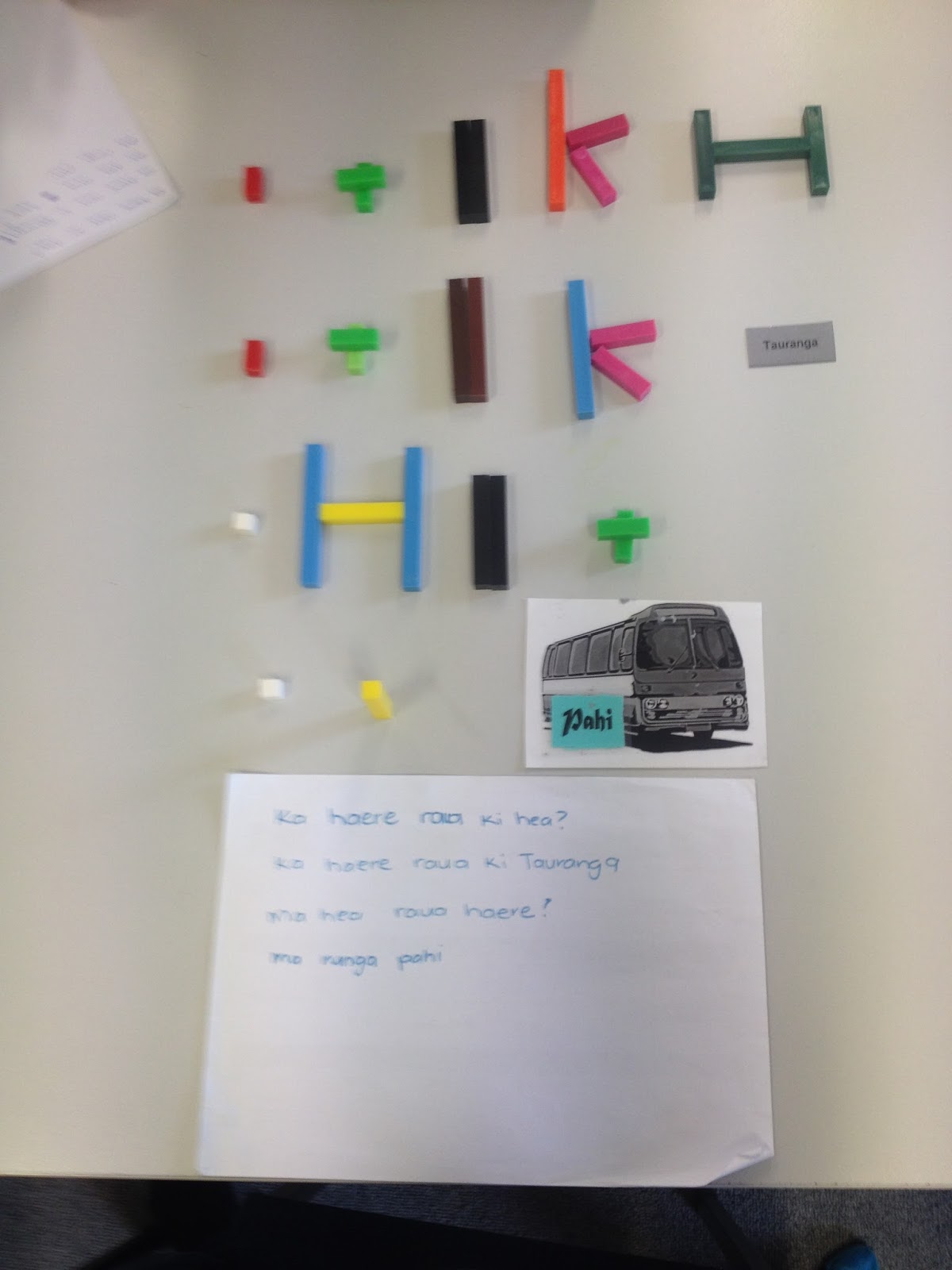
This Saturday I had fun at a one day Wananga, as part of my Level 2 Te Reo Māori paper. I have been able to advance my knowledge through this professional development.

In this activity we were divided into groups and each person had an opportunity to teach one sentence structure to the group. We were challenged to korero Māori throughout our explanation. At first I was nervous but soon I was able to grow in confidence and enjoyed the experience.


Making booklets for our Haerenga - Holiday plans

Friday, 26 June 2015

Are we raising kids for now instead of yet?


Growth vs Fixed mindset (Carol Dweck)
http://www.ted.com/talks/carol_dweck_the_power_of_believing_that_you_can_improve?language=en

Are we raising kids for now instead of "yet"?
Are we raising kids obsessed with A's?
Are we raising kids to dream big dreams?
How can we build the bridge to "yet"?
Praise wisely (their effort, their strategies, their focus, their perseverance, their improvement)


I agree with Carol Dweck that having a mindset that believes you are capable, you can learn and grow is essential for my students.

How can I put this into practise in my teaching?

  • praise students wisely not on their talents but on their effort, improvement & progress
  • notice students who appear to have a fixed mindset and start finding ways to change this 
  • have a growth-mindset myself
  • speak to colleagues about how they foster growth-mindsets